Experience report Clinic Nepal – April 2023
Roswitha Strauß spent two weeks in Meghauli as part of her sabbatical and offered pedagogical coaching for the educators of the Wolfgang Linke Kindergarten.
As part of my sabbatical and a seven-week trip to Nepal, I also spent two weeks in Meghauli in April 2023. I got to know the members of the Bhandary family at the Freiburg Christmas market. I had agreed with Hari Bhandary, the founder of the clinic, to offer coaching and training for the educators of the Wolfgang Linke Kindergarten, which belongs to the clinic, as part of my visit to Chitwan.
I was welcomed very warmly (musically) at the kindergarten and also curiously eyed. After two days of accompanying the four educators and the roughly 50 children as an “observer”, we agreed on a fixed time at which we wanted to meet each day. Since my stay fell in the time of the “exams” (we would probably rather call them school readiness tests), the children finished at 12 noon already, and so there was a daily time frame of 1.5 hours in which we could work.
My accompaniment of the educators' team was not subject to any requirements, so that I could act “freely” in pedagogical terms. After my two days of observation and in consultation with those responsible at the clinic, I initially set the focus on the educators themselves, and we worked out their self-image, their personal and professional goals and their work in the team.
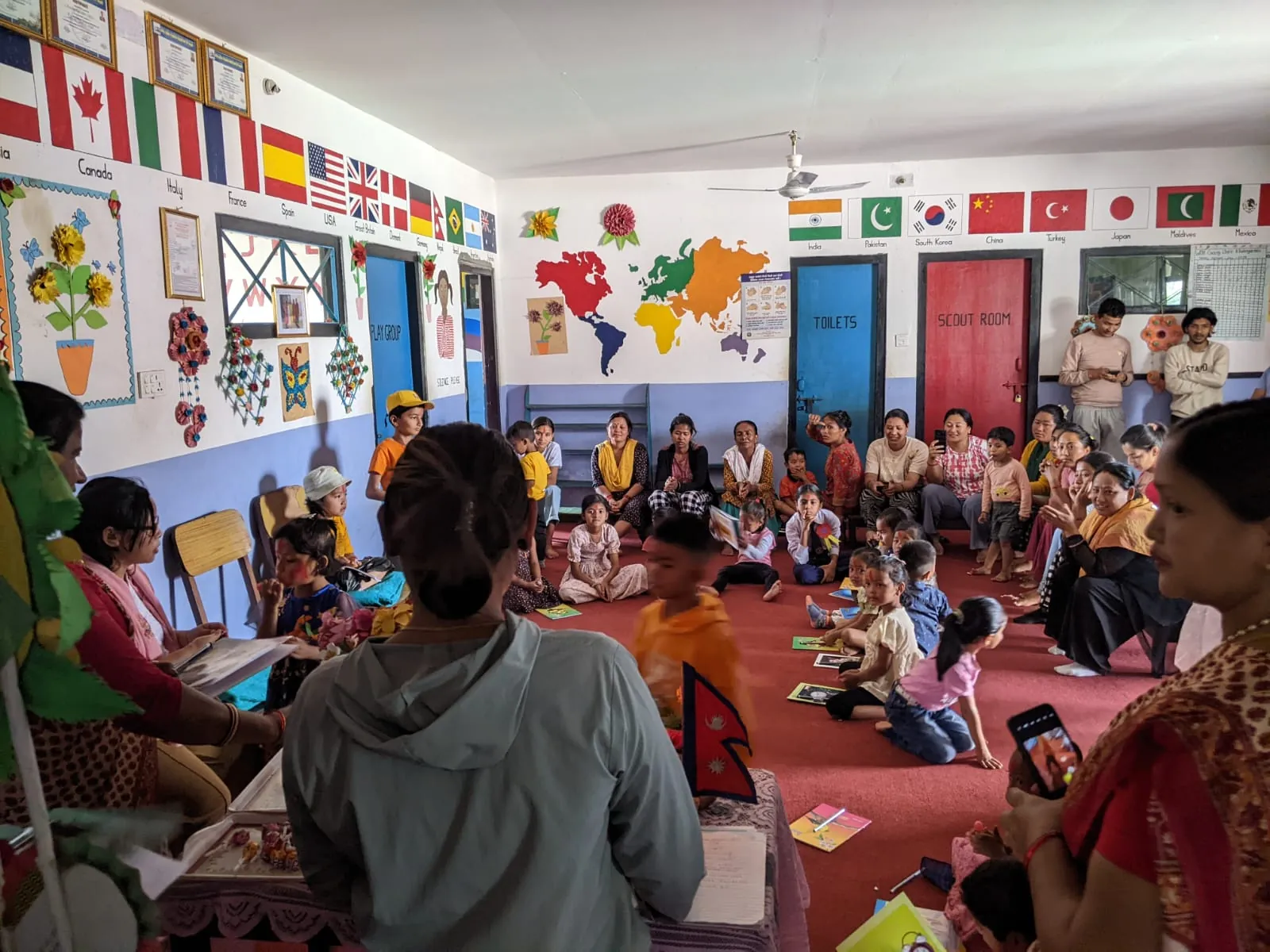
For me personally it was very exciting to do this in English. For the kindergarten teachers it was also a challenge, because on the one hand this kind of reflection seemed unfamiliar to them, and on the other hand only two of them could speak English passably. So it was translated into Nepali again and again, also with the help of outside people (e.g. the sister-in-law, who was visiting at the time). The results of the training work were also recorded in exercise books.
My basic training in Theme-Centered Interaction according to Ruth Cohn proved helpful for our work together, as this method was easy to convey for group leadership and also seemed comprehensible and plausible to the educators (EZ).
In the last part we developed new ideas and play materials (e.g. Kapla blocks, Magnetformers, crafting with paper, new songs and movement) through practical activity. Again and again I asked the educators (EZ) to exchange views on the pedagogical value and quality of the materials. It also helped us that one educator had her three-year-old daughter with her, whose enthusiasm for simple, natural play materials made it possible to explain a lot vividly.
A particularly cheerful conclusion came about because the scouts, who have a room in the kindergarten building, practised and played the card game UNO together with us in the last lesson.
What remains?
For me, a special encounter with warm-hearted, open-minded people who were willing to engage with something new. Also an experience that taught me to appreciate our German “matter-of-course things” and our material wealth in the pedagogical field anew. Finally, once again the realisation that successful work in the pedagogical field depends on many factors.
What is needed?
First of all money, to buy urgently needed play materials with which the children can better practise free play. Only in this way do they learn to work more haptically, to use their imagination from an early age and to interact more socially. The kindergarten building itself has aged and needs renovation.
Donations for the kindergarten are therefore very welcome!